Harris Teeter Weekly Ad
Harris Teeter Weekly Ad: Current Deals, BOGO Offers and Savings Guide
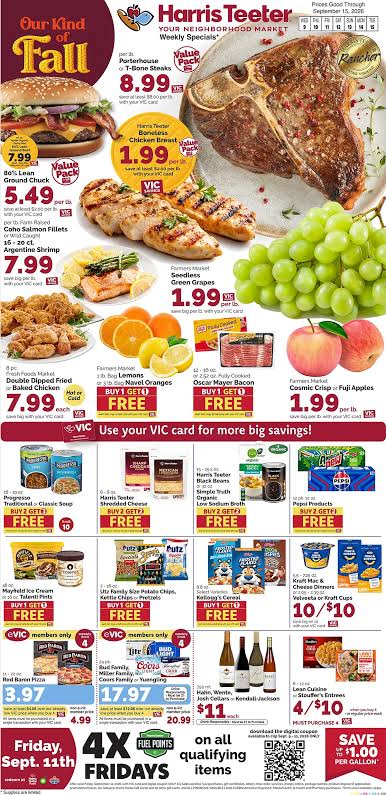
The Harris Teeter weekly ad is one of the easiest places to begin planning a grocery trip, but the most useful savings strategy goes beyond scrolling through circular pages. A shopper may need to confirm the right store, understand whether a price requires a VIC card, compare a BOGO promotion with a regular unit price, and decide whether a digital coupon changes the final cost. This page is designed to bring those steps together in one independent guide.
Harris Teeter’s official help center states that the new weekly ad is normally available at midnight Eastern Time on Wednesday. Stores in Indiana, except Southeast Indiana and Evansville, Illinois, and Eastern Missouri follow a Thursday update schedule. The official site also ties the weekly ad to a preferred store, so an independent guide should never imply that one price list is universal.
Use the live weekly ad for current products and prices, then use this guide to understand how to read the promotion, compare offers, and build a focused shopping list. The goal is not to reproduce the official circular. It is to help readers interpret it accurately and avoid common mistakes such as assuming every store has the same inventory or treating every highlighted promotion as the best value for every household.
How the Harris Teeter Weekly Ad Works
For shoppers researching Harris Teeter weekly ad, the section on how the harris teeter weekly ad works should answer a concrete planning question rather than repeat a sales headline. The ad is a time-limited list of promotions connected to a particular store and weekly sales cycle. First, explain that the shopper should select the correct store before relying on a price or promotion. It is also important to note that weekly specials can include standard sale prices, VIC prices, multi-buy promotions, BOGO offers, and featured seasonal items. A second check is whether availability can change during the week, especially on heavily promoted items. In practical terms, the live store page should be checked for the selected location, current dates, and exact product terms. That distinction lets the evergreen explanation stay useful even after the featured products rotate out.
- Check the ad dates before creating a shopping list.
- Confirm the preferred store or location.
- Note whether the price requires a Shopper’s Card/VIC account.
- Read package-size and quantity limits carefully.
Best Way to Read the Ad
Best Way to Read the Ad is where a Harris Teeter weekly ad page can turn raw promotion information into something a household can actually use. A good first pass is to separate true household needs from eye-catching promotions. It is also important to note that start with staple products the household already plans to buy. A second check is whether compare unit price when package sizes are different. Readers benefit from knowing that flag BOGO and multi-buy deals for a second review rather than assuming they are automatically cheaper. The page should make clear that look for digital coupons or e-VIC offers that may apply to the same shopping trip. Before the shopper acts on the offer, the reader should confirm the current price and eligibility in the Harris Teeter ad tied to the preferred store. Keeping those details visible reduces the chance that a reader mistakes a regional or expired offer for a universal price.
VIC, e-VIC and Digital Savings
Readers who search for Harris Teeter weekly ad often need context around vic, e-vic and digital savings, not another copy of a circular image. Harris Teeter uses several savings mechanisms, and each one can affect the final checkout total differently. A second check is whether vIC or Shopper’s Card pricing can be different from the regular shelf price. Readers benefit from knowing that e-VIC can highlight sale items and member-only savings. The page should make clear that digital coupons are loaded to the Shopper’s Card and redeem when qualifying conditions are met. Another useful detail is that digital manufacturer coupons and paper manufacturer coupons are generally not stacked on the same item under the current coupon policy. From a budgeting standpoint, the final decision should use the active offer for the shopper’s location rather than an undated screenshot or archived price. By separating the rule from the weekly example, the page remains easier to maintain and less likely to carry stale information.
BOGO and Multi-Buy Promotions
A strong explanation of bogo and multi-buy promotions gives Harris Teeter weekly ad readers a way to judge the offer before they add it to a list. BOGO deals deserve a separate check because quantity and online-shopping behavior can affect the result. Readers benefit from knowing that harris Teeter treats each BOGO item as a separate purchase for coupon purposes. The page should make clear that for online shopping, shoppers should enter the quantity needed to trigger the intended BOGO or B2G3 structure. Another useful detail is that a half-price treatment can apply in some online BOGO situations when only one item is ordered, according to Harris Teeter online-shopping guidance. For a household comparing several options, the product description, size, quantity rule, and member requirement should all be checked against the current store listing. For SEO and usability alike, that is stronger than padding the article with the same weekly-ad language on every URL.
Build a Better Weekly Shopping List
The practical value of build a better weekly shopping list is that it connects the promotion to budget, timing, quantity, and store context. The strongest list is organized by department and by certainty, not by the order products appear in the circular. The page should make clear that group produce, meat, dairy, frozen, pantry, beverages, and household items. Another useful detail is that mark must-buy items separately from optional stock-up deals. For a real shopping trip, remember that add coupon or VIC notes beside each item so checkout conditions are not forgotten. When examples are updated, confirm that leave room for substitutions when an advertised product is out of stock. For readers checking a deal on mobile, the shopper should verify that the offer is still active and that the selected store is the one intended for the trip. The result is a page that supports a shopping decision instead of merely reproducing promotional material.
List Type | What to Add | Why It Helps |
Must Buy | Regular household essentials | Prevents impulse spending |
Best Deal | Strong price on a planned purchase | Prioritizes real savings |
Stock Up | Shelf-stable item at a meaningful discount | Supports longer-term value |
Optional | Interesting promotion not originally needed | Keeps impulse buys visible |
Common Weekly-Ad Mistakes
On a well-maintained Harris Teeter weekly ad page, common weekly-ad mistakes should be written for someone making a real shopping decision. Most problems come from reading the headline but missing the promotion condition. Another useful detail is that a price can be tied to a specific size, flavor, quantity, or card requirement. For a real shopping trip, remember that a promotion shown online may not mean every location has inventory. When examples are updated, confirm that an expired circular should not be used to predict the current checkout price. First, explain that independent deal pages should label examples and archived prices clearly. In practical terms, the current Harris Teeter listing should be treated as the final reference when a price or condition could have changed. This structure is especially helpful on mobile, where readers need the conditions summarized before they reach the checkout line.
How to Keep This Page Accurate
Because harris teeter weekly ad can change with each sales cycle, review the dated portions on a fixed schedule. Replace expired examples, confirm the selected-store context, and keep a visible last-reviewed date so readers can tell when the page was checked. Evergreen explanations can remain, but any policy-based statement should be revisited when Harris Teeter updates its official help pages.
- Confirm the selected-store or location context before publishing prices.
- Replace expired weekly dates and remove stale deal labels.
- Check official Harris Teeter help pages when describing rules or account features.
- Do not imply that every store carries every advertised product.
- Keep internal links pointing to the current evergreen deal and coupon pages.
Frequently Asked Questions
The official help center says the new ad is normally available at midnight ET on Wednesday, with a Thursday schedule for specified stores in Indiana, Illinois and Eastern Missouri.
No. Harris Teeter connects the online weekly ad to a preferred store, and prices or availability can vary by location.
Some promotions are tied to VIC or Shopper’s Card pricing. Check the live offer details before relying on a highlighted price.
Digital coupons can apply when the product and offer conditions match. Current policy limits coupon use on the same item, so read the coupon details and checkout rules.
Not necessarily. Compare the effective unit price with alternatives, package sizes, store brands and what your household will actually use.
Availability can change. Check the live store page, ask the store about alternatives, and review rain-check rules where applicable.
Use independent sites for planning and interpretation, but verify live prices and conditions with Harris Teeter before purchasing.
Final Takeaway
The Harris Teeter weekly ad is most useful when it becomes the starting point for a disciplined shopping plan rather than a list of products to chase. Verify the correct store and dates, identify the promotions that match real household needs, then layer in VIC, e-VIC and digital coupon savings where the rules allow. Keep the live Harris Teeter page as the final source for price and availability, and use this guide to make the circular easier to understand.